Sunday, May 9, 2010

Around the house.


I recently made a few changes that make my salon much more hospitable. A local carpenter built some risers for my ponj cushions. Lifting them off the floor, in a more sofa-like manner, has made my aging back much happier.

I then decided to move my dining table/desk/clutter collector into the main room, and finally hung an original watercolor by a would-be student who has never returned for class. Snapshots of the folks back home, and various works by my dar chebab kids, round out my art collection.

Speaking of household appliances (or at least furnishings), thanks to Faye I have successfully been telling my first joke in the local language:
A young man tells his mother that he's ready to begin looking for a wife.
Mom: "Well, what kind of wife are you looking for?"
Son: "I want one who is tall, white (i.e., fair/beautiful), and will spend all her time in the kitchen, working hard day and night."
Mom: (heavy sigh) "Son, you want to marry the refrigerator?"
It's obvious when I tell it that it's an old, old joke, but it still kills ~ most likely because people are so delighted I can actually tell it.

More from the 'donations' box.


Finally got some bookshelves put up in my classroom. So far, they look a little sad ~ not just for all the open spaces, but for the content ~ or lack thereof. All of these books have been donated from U.S. agencies working in Morocco. Not much thought is put into whether these are books Moroccan children can/will actually use/want (for context, see previous post here).
From the wildly inappropriate to the outdated to the simply out of place or downright boring, we've got it covered:

* A 1985 guide to road trips across the United States
* 1999 World Almanac
* a 2000 guide to using the Internet
* "How to Write a Report" ~ 1968 edition
* Youth fiction: "Preacher's Boy"
* Gardener's Guide to Pest Control
* Biographies of Margaret Sanger and Brigham Young
* "The Age of Voltaire" from Will and Ariel Durant's 11-volume "The Story of Civilization"
* 3-volume set: "An Outline History of Switzerland: From the Origins to the Present Day;" "The * Social Structure of Switzerland;" "Philosophy from Switzerland"
* "Shane" ~ the 1949 novel that became a classic '50s Western
* "Each Time, Every Time" ~ an oversized set of colorfully attractive, easily readable graphic novels about AIDS and STIs. Kid-friendly. A bit too kid-friendly for this culture. I want everyone to have this information, but I don't particularly enjoy being the one to translate "I'm passing this white, sticky stuff" to an eager-to-read 14-year-old boy.

I'd give anything for some Shel Silverstein, some Beverly Cleary, some Eric Carle. Basic picture books with beginner words in English. Easy-to-read, youth-oriented texts.

Still, even this incongruous collection is fascinating to my kids, who don't usually see bookstores or libraries, who don't live in a culture that places any value on pleasure reading. They love to pull them out and look at them. That's a good start ... and the obsessive-compulsive in me is doing an excellent job of letting them touch and jumble the tomes, resisting the urge to keep things in order. Disorder is good! The books are there to be used, examined, played with, explored. Just don't make me explain "white sticky stuff." Please.

OPALS at the dar chebab.

Waiting their turn.
Few weeks back, the director of my dar chebab casually mentioned that I should come by the next morning (I don't usually work until late afternoon, when kids start getting out of school) because "women will be here."

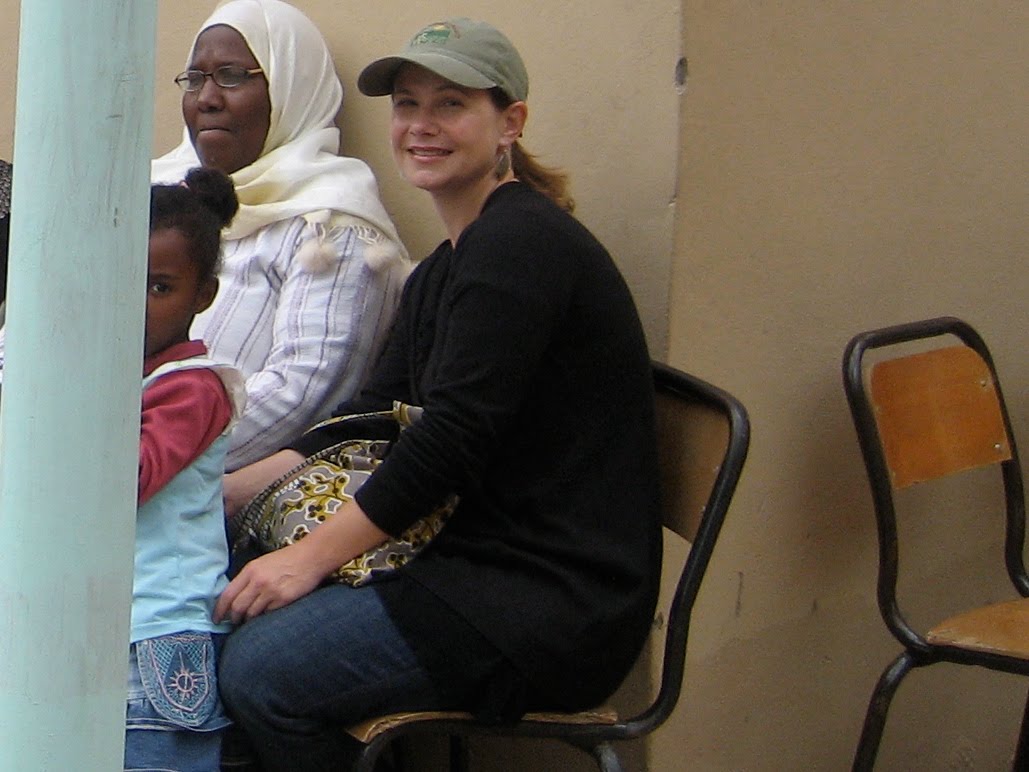
OK. I came ~ and was shocked to find the courtyard filled with at one point perhaps 50 women, all waiting to see "the doctor."

OPALS' traveling clinic.

The "doctor" was OPALS ~ one of two major organizations in Morocco that work to combat SIDA (AIDS). They were offering free HIV tests. That's all. I never could get a handle on whether the women realized that and were smart/brave enough to come for the tests, or whether they were hoping to have various ailments treated. I sat with the waiting women, several of whom mentioned having high blood pressure, or rheumatism, or other miscellaneous aches and pains. Were they disappointed? Offended? They didn't seem so.

Late into the afternoon, long after the OPALS truck was gone and I was trying to teach various levels of English in one chaotic classroom, the women kept coming, poking their head in the door to ask where the doctors were. My conspiracy-laden mind started to wander, and wonder: Were the women lured in with promises to be treated by a doctor ... or were they smart enough to *pretend* they had come for other purposes, so they wouldn't feel ashamed to be getting an HIV test? Or am I looking for issues where none exist, and they're simply smart and educated enough to know that everyone should be tested, on a regular basis?

Either way, they got tested, and that's a good thing.

With my new friend Aicha and her little girl, Hajar.
And my other new friend, also conveniently named Aicha.

Getting pulled into the "group picture"


Monday, May 3, 2010

Women on the run.

Early morning run/walk along the beach in Agadir.

Riding in the taxi to Agadir, on my way to our long-awaited Women's Wellness Weekend, I suddenly had a burst of trepidation: Had I set my hopes far too high? I knew the dozen-plus Peace Corps volunteers involved (all female!) were enthusiastic and prepared. I knew the women we were bringing from our respective villages were excited for a new adventure and curious about their bodies. I knew had we strong and dedicated Moroccan advocates to present the information. But would any of it transfer into our ultimate goals ~ to give our women health and fitness information they could put to actual use and share with more women in their communities?
In fact, the weekend proved to far exceed my highest expectations. The 24 young Moroccan women at the workshop forged strong new friendships while learning basic health education that we take for granted. Even better, my shy young ladies from the women's center have taken the concept of sharing what they learned and are running with it. Better health, education, empowerment and leadership ~ this weekend was a highlight of my Peace Corps service, and a week later I still can't write about it without tearing up.

Getting to know each other: With each twist of the string around her finger, each participant had to share something about herself.

Yoga, sort of.

We started Friday with a getting-to-know you session ~ many of our participants rarely have a chance to meet counterparts from other communities, and we all warmed up to each other right away. Then I led the first of the weekend's three sport sessions, explaining (or trying to) some of the basics of yoga and the virtues of stretching, flexibility and mindfulness.

Saturday morning, armed with water bottles for weights, we speed-walked our way to the beach for a walk/run along the coastline. The air was cool, the setting idyllic, and there is nothing more exhilarating than seeing a couple dozen women of all ages, sizes and abilities, in conservative dress or not, take over a beach typically dominated by postadolescent boys and, literally, run with it, smiles on their faces the entire way.

That was just the beginning of a truly inspirational day. Atika from the Association Marocain de Planification Familale led a lengthy, detailed session on the gynecological system, menstrual health, family planning options and how to obtain them, SIDA (AIDS) and other STIs and more. I was worried there would be complaints that such information was hchuma ~ shameful ~ and there was a brief discussion, but Atika knew just what to say in response. She kept everything fact-based and yet culturally appropriate. And you could see the women's brains just inhaling the information. I would bet that for many, it was the first time they'd heard the actual facts.

Mounia, a high school student with all the charisma and drive of a future prime minister, took the reins for a session on breast cancer awareness, symptoms and self-exams. Peace Corps volunteers led sessions on handwashing and basic hygiene, first aid, and making reuseable menstrual pads ~ the latter being another subject we thought the ladies might not be ready for, and they again surprised us with their enthusiastic embrace of the idea.


Stretching before aerobics.

Sewing "gladrags" ~ homemade, reusable menstrual pads to replace the wildly expensive commercial variety.

Sunday morning, after a high-energy aerobics session, we sat in a circle and Amal, our local counterpart who helped us with all the logistics, asked the participants to share a little bit about what they had gotten out of the weekend. The waterworks began, and this is when we knew the weekend had been a success ~ not only could the young women articulately and movingly describe how important the information was to them, they were truly sad to see the weekend come to an end.

But this is the beauty of the plan, for the end of the weekend was only the beginning of the project. My young ladies immediately started plotting how they would share the weekend's information at the women's center. This Thursday, we'll do a short gladrags session. Next week, Atika from AMPF is coming to lead another session on basic gynecological health in our village.

From there, totally on their own initiative, my young ladies are ready to gofarther than I would have dared hope ~ they want to take the show on the road! They've already spoken with Atika, acquired her PowerPoint materials, and want to visit the duoars ~ the remote villages that dot our region, to serve women who rarely leave their homes, much less their villages, many of whom have never had any type of education.

All it took was an opportunity ~ for these women to learn something new and then see that they had something to share with others. I didn't do a thing but get them to the workshop, but I couldn't be prouder of them.

After every photograph, the demand to Nchuf! Nchuf! ("Let me see!")

Group photo.

Me with my beautiful young women from the village.

At dinner the Saturday evening of the workshop, I sat with the women from my village. We discussed what we'd learned that day and how we might share it back home. I mentioned how they would be role models for other young women.

"But Becki ~ I'm not a role model," sweet, bespectacled Fatima, my quietest participant, told me.

Why not, I asked.

"Because I didn't finish school."

I couldn't adequately say everything I wanted to tell her, but I could tell her a simplified version of this: Fatima, you and your friends are the ultimate role models. You don't just sit at home, watching television, wishing for more. You didn't have the opportunity to finish school, but you seize every opportunity presented to you. That is education. And you want to share everything you have, everything you know. That is leadership. You want more for your future daughters. That is everything.

As usual, tons more pics here: http://www.flickr.com/photos/71994606@N00/sets/

Wednesday, April 14, 2010

Camping it up.

As many of the 107 campers as would heed my instructions to Zidu! Zidu! ~ crowd in. I like the kid on the left, in the red shirt, doing the Moroccan symbol for "crazy. "
Told you it'd take me time to rest up enough to tackle a proper account of English Camp Taroudant 2010. But I didn't mean for it to take me nearly two weeks.

I have to admit, I was a bundle of nerves heading into this thing. Who in their right mind willingly signs up to coordinate a camp for 100+ kids who speak English (if at all) as a third or fourth language, armed only with 9 other Peace Corps volunteers, a nearly equal number of Moroccan counselors, an industrial sound system and a couple dozen sheets of butcher paper?

Turns out I had less than nothing to worry about. Sure, the mother of all head colds decided to crash the party just as things were getting started. Sure, we averaged about 5 hours of sleep a night. Sure, we welcomed our maximum number of campers and then some (107, to be exact). Sure, printers didn't work and schedules didn't mesh and there was the occasional paint explosion. But if those were the greatest of our worries, all I can say is hamdulilah.

Go bananas. You know you want to.

Chick-a-Boom ... underwater!
This is the third camp I've worked here in Morocco. Previous ones have been blemished by bickering between Peace Corps volunteers, between American and Moroccan staffs, between Peace Corps coordinator and Moroccan camp director, between volunteers and youths, between the youths themselves. There've been kids caught stealing, smoking (you name it), drinking, having sex, fighting, vandalizing. There've been breakouts and breakdowns and hookups and rumbles between urban/rural factions. Camp funds have gone into unknown pockets instead of such things as class materials or food for the kids. Frankly, my previous experiences had me desperately wishing I never, ever had to work a camp ever again.

But Camp Taroudant was about as good as it gets, and we didn't even have a beach to use as a bargaining chip. The kids were well-behaved, enthusiastic and actually inquisitive. The staffs got along famously, and we had an angel of a camp director, who worked at least as hard as we did, danced as hard as the kids did, and has a penchant for Pink Floyd's "Another Brick in the Wall."

Our success can only be blamed on the nine intrepid Peace Corps volunteers who signed up to work with me. Ali, Ariel, Joy, Laila, Lori, Matt, Michelle, Nicole and Vish didn't just do their time. They worked hard, around the clock. They turned on the charm with the kids. They practiced in their spare time. They propped each other up when propping up was needed. They swapped ideas and strategies and kept each other laughing. They made the whole dang thing fun, not just for a boisterous crowd of Moroccan adolescents, but for a middle-aged Midwesterner who came in more than a little dubious and left with new friends, new music and a new appreciation for the possibilities of engaging youths.
Ariel's class got a lesson in Somali politics along with their English via the song "Wavin' Flag."

Joy and her budding artists. This is "during." The "after" is, thankfully, not recorded for posterity.

and Bingo was his name .... (substitute awkward fadeout for trying to explain name-oh)
Not that we didn't have any problems; we just managed to, well, manage them. The main one was the number of kids, especially the number of entry-level English learners. We'd organized four English classes ~ two beginners, one intermediate and one advanced. A couple more beginner classes would have made a world of difference; Lori and Matt's classes were overwhelmingly full. They handled it with aplomb, though, with a lot of help from Ali, Joy, Laila and Vish. As for the intermediate and advanced classes, Michelle, Ariel and Nicole really boosted their students' conversational abilities ... not to mention their rapping skills.
Vish's New Zealand club gets into their haka dance at the spectac.

A visit to the tannery just outside Taroudant's medina. Giddyup!
The final night of camp is traditionally the SPECTAC! Short for spectacular, very much in the spirit of an old Andy Hardy flick ("Hey, kids! Let's put on a show!" ... and yes, I know I'm dating myself here. Wikipedia it, kids.) Much of the last two days of camp were spent practicing our performances for Friday evening. Each class and each club prepared a number, and American taxpayers should be pleased to know that a select group of youths in Taroudant province are now fluent in the Black-Eyed Peas' "Where Is the Love," the Maori haka war chant, K'naan's "Wavin' Flag," the Maasai jumping dance, "Hello Goodbye" by the Beatles, the enduring classic "B-I-N-G-O" and a taste of Bollywood dance. We wrapped it all up with a mock Berber wedding procession and an official Peace Corps performance ("best part!") of "Thriller" that came off well enough despite my stumbling in the back row.

We kept 107 kids pretty well entertained for seven days, and if they came away speaking a little more English via the Banana Song and Chick-A-Boom ad nauseum ... well, who could ask for more?
Little 12-year-old Ibtissame from my dar chebab was the youngest camper, and possibly the most enthusiastic.

Camp schedule:
7:30 a.m.: Wake up, get dressed, make beds
8 a.m.: Morning activities (national anthem, a few wake-up songs, announcements, Stars of the Day
8:15 a.m.: Breakfast
9-11 a.m.: English classes
11:15-12:30 p.m.: Sports/recreation
1 p.m.: Lunch (followed by much-needed naptime)
3:30-5:15 p.m.: Country Clubs (we divided kids into a cross-section of Anglophone countries to practice English while learning history, culture, music, art and more about their assigned nations ~ Canada, Jamaica, India, Kenya and New Zealand
5:30-7 p.m.: Activities with Moroccan counselors ~ or ~ outings in which we inflicted all 130 or so of us upon the unwitting streets of Taroudant
8 p.m.: Dinner
9-10:30 p.m.: Evening activities (these ranged from talent show to crafts, games, movies and of course the SPECTAC!
11 p.m.: Lights out (inch'allah)


Campers' best quotes:

"Becki is a vegetable. Are you a vegetable?" ~ asked of a fellow vegetarian
"WHAT FROM YOU?" ~ urgent query put to Laila during a game where students were trying to guess our national origins
"I want power. All I need is money, guns, and the love of my parents." ~ aspirations of a student in Ariel's intermediate class

My amazing crew of intrepid, inexhaustible, invigorating PCVs. Thella yfraskum!

300+ more camp photos here, if you have the interest/patience: http://www.flickr.com/photos/71994606@N00/sets/72157623679130607/

Ki dehek.*

A rainy, dreary day ... the sun keeps trying to poke its head out, but the clouds have repeatedly beaten its sunny ass and told it to get back inside if it knows what's good for it. A day better spent curled up reading with a cup of tea than slogging through the muddy "streets" of my village to get to the dar chebab.

I almost didn't go. But if I hadn't, I would have missed out on one of those little everyday moments that repeatedly remind me just how much fun this "youth development" gig can be.

Only two kids braved the rain to meet me, but they were my two best middle-school students. At 14, Brahim and Abdsamad know way more English than most high-school seniors (thanks, Fox Movies!). I helped them review body parts and clothing for an upcoming quiz at school. Most of the basics they could rattle off easily, so I challenged them with new vocab like "polo shirt" and "eyebrows" and "kneecap" (it's a cap for the knee, get it?)

Brahim drew a diagram of a person, labeling everything as we went. We played a little "Simon Says." I answered several random vocab questions, some pertaining to the body, some completely unrelated.

Brahim wrote the word "fanny" on his paper, then ~ the universal symbol for "not equal to."

Oh, dear. What are you trying to ask me, Brahim? And where on earth did you hear an old-fashioned word like "fanny"?

I debate whether I'm even gonna get into this, the naming of the backside, the bottom, the butt, the bum. Whatever you wanna call it, it can't be anything but hchuma to discuss it with a couple of adolescent boys. (And what's with the "≠" sign? Just how bad is this gonna get?)

They're perplexed by my reluctance.

"Like you are fanny," Brahim further explained. Not helping, Brahim.

"You are fanny, and I am not ~ what is opposite of fanny?" Abdsamad adds, striking a fiercely stern schoolteacher pose.

Aha. I'm slow to catch on. They don't want to talk about my fanny, they're trying to tell me I'm funny ~ and the word they're looking for is "serious."

In the end, just so they could truly appreciate how funny this was, I did in fact explain why I was so confused.

I haven't laughed that hard with 14-year-olds since the time Kelly and Shon stuffed me in a trash can in Mr. Wengert's 8th-grade math class.

(The boys also informed me that I have short eyelashes. So, there's that, too.)

* It's funny!

Wednesday, April 7, 2010

Category: Random.

OK, this is one of the stranger videos I've seen while visiting the host family. A Moroccan singer/guitarist with a growly Sheryl Crow voice, English lyrics, a cowboy/sheriff-type character wielding a big stick, prisoners in '30s-era stripey uniforms a la "Oh Brother Where Art Thou" ... and a deep desire to perform on "The Muppet Show"? Yeah, those themes all converge quite nicely. Enjoy!


Promise I'll post an update on our Spring Camp in Taroudant just as soon as I fully recover ... which should be sometime in October. Short version: It was awesome, thanks to a truly spectacular group of volunteers. Thank you Ali, Ariel, Joy, Laila, Lori, Matt, Michelle, Nicole, and Vish-o!

Tuesday, March 9, 2010

In which we celebrate women.

Ibtissame makes a card for her mother for International Women's Day.

“Women are still the majority of the world’s poor, unhealthy, underfed, and uneducated. They rarely cause violent conflicts but too often bear their consequences. Women are absent from negotiations about peace and security to end those conflicts.”
~ Secretary of State Hillary Rodham Clinton on International Women’s Day


Not the most upbeat description of women’s status worldwide, but an honest one. It is good to remain open-eyed to realities in the world ~ realities of wage disparity, female genital mutilation, suppression of basic human rights, lives lived in war zones. If we don’t acknowledge it, we can’t work to change it.

Yet it’s also important to celebrate successes. Morocco is slowly making strides toward greater equality for women. Major reforms of the moudawana, or sharia-based family law, in recent years have given women more rights in marriage and divorce. Certainly much work remains for these rights to be widely accepted and practiced, but it’s a start ~ and one led by a popular and powerful king. As a relatively progressive Muslim country, Morocco does not put women under the dictatorial restrictions that exist elsewhere; women can drive, hold jobs, participate in their government or protest against it. They are not required to wear the veil. They are not sequestered within the domestic sphere.

Of course, much remains to be done. Illiteracy rates are still far higher, and education levels far lower, for women than for men. While the veil is not required by law, and women are free to leave their homes, the truth is that in rural areas such as where I live, social pressure does not make it easy on the rare woman who chooses to exercise such freedoms.

Education is the answer to equality, across the globe. Better education brings better opportunities, and gives both sexes a greater understanding of why equality promotes peace and prosperity for all. I’m so proud of my kids, girls and boys, who are so eager to further their education. And I’m sad for the occasional girl who leaves school at 13 or 14, because her family either requires her to help out in the house or to work in a shop to keep food on the table.

Mad card-making skills (and check out the lingering mold on the walls of the dar chebab).

We didn’t quite get around to all of these concepts during my International Women’s Day exercises last week. But we did scratch the surface with great enthusiasm. My nedi ladies added the words “equality,” “rights” and “respect” to their English vocabularies, and learned to conjugate “to be able” ~ as in, “Women can do anything! I can do anything!”

On Saturday at the dar chebab, we made cards for our mothers to celebrate the work they do for us every day. My plan was for a chance for my “little girls” (13 and under) to exercise their creativity while thinking about the simple idea of women’s equality. At first I was afraid I’d have an empty classroom, on a rare sunny day, but eventually about half a dozen girls showed up.

Next thing I knew, I had an equal number of teenage boys on my hands ~ older teens, 15-18. The dar chebab was set up for an event the next day, so they couldn’t play pingpong or any of the other games we usually play. One of the boys sidled up to me, asking whether they couldn’t color, too. I explained the concept, prepared to have to kick out a handful of rowdy boys all taller than me, expecting them to make fun of the concept, commandeer the supplies, make too much noise, make fun of the girls, make fun of me.

I love it when I’m proven wrong. The boys got right down to business and were into the idea from the start. They developed creative card designs and tried to stay on message. They respectfully traded ideas and sneak peeks of their work with girls half their age.

"Hi, Mom!"


One boy was proud to have used four different languages on the cover of his card, mixing Arabic, French, Tashelheit (the local indigenous Berber dialect) and English. He even taught me to write “mama” in Tashelheit, which looks something like this: [•[•

Another, for some reason, addressed his card to “This Frail Mother.” Something lost in translation there, I assume.

My little girls always love to show off the English they know. I helped them spell “love” and “mother” and “beautiful.” One girl drew a Happy New Year card, so enthusiastic was she to combine her knowledge of English with her knowledge of English-language greeting cards.

I tried to keep stressing that these cards were for their moms, who should be able to understand them, and maybe we should stick to pictures, and maybe we should go home and thank them for working so hard, every day.


Little things that make me happy.

My village's back yard. Admit it: When you think of Morocco, this is not the vista that comes to mind.

* A successful trip out into the country to judge whether the dirt roads have dried out enough to run on. Still boggy in a few places, but definitely negotiable. And, thanks to those rains, so surrounded by dense green fields that I lost my way once, a familiar trail strewn with so many random wheat stalks that I didn’t recognize it.

* My anniversary: I’ve been in country 18 months as of today.

* Things viewed from the bus on the ride to Taroudant: Goats in trees, munching the argan leaves (it’s a local oddity that I don’t actually get to see in action, but goats really do climb trees here!); a flock of sheep that I have dubbed “Black and Tans,” pitch black except for a swath of beige across the midsection, not just one but the whole flock of ’em; what looked to be Hereford cattle; spicy orange-red bougainvillea and hibiscus.

* A successful shopping trip in Taroudant that netted cherry tomatoes, strawberries, avocadoes, green beans and orange-infused honey.

* A shout-out from the back of the bus as I boarded for home, laden with shopping bags. It was Soumia, my bac student from last year. She goes to accounting school in Taroudant now. She has an internship at a bank next summer. She invited me to her house out in the country Sunday. It was good to see her doing so well ... and still speaking English.

* A mystery couscous delivery last Friday: A little girl knocked on my door, handed me a steaming covered plate, said “Mama says hi,” and ran away without answering “Chkun mmk?” (“Who’s your mother?”) I hope someone eventually comes looking for her dishes and her secret identity thus will be revealed …

* A gift bestowed upon me as I was leaving the women’s center today after class. Fatna pressed a battered cassette tape and a scrap of paper into my hands, telling me they were about Islam, “only if you want them.” Sometimes volunteers feel harassed by proselytizers; sometimes I do, too. But this wasn’t the “Hello, you speak Arabic, are you Muslim? No? You should convert!” kind of conversation we often have with strangers. This was so heartfelt: She waited until she knew me well; she went to the trouble of finding Web sites that explain the Koran in English; she made a point of saying it was only in case I might be interested. I actually feel quite touched that Fatna cares enough about me to share with me what she so obviously considers a great gift.


More photos of spring.

Just gotta dodge the puddles.

The star of Morocco's flag, in triplicate.

Spring comes on with a vengeance.

Wednesday, March 3, 2010

Women, film and funds.

So many of my family, friends and blog readers have asked how they can help us do our work here in Morocco. Well, here's an easy answer!

My friend, Peace Corps compatriot and fellow Gender and Development Committee member Cortney has launched an amazing project to raise awareness of women's rights in Morocco. What started as a plan to film some successful Moroccan women, to promote leadership and gender equality among youths, has morphed into a budding NGO (nongovernmental organization) of female Moroccan leaders, a network to help them effect change in their communities, their country and themselves.

To get the film portion of the project off the ground, Cortney is seeking funds from folks back in the States. Even $5 or $10 can help us toward our goal. Go here for more information and to make a donation:

https://www.peacecorps.gov/index.cfm?shell=resources.donors.contribute.projDetail&projdesc=378-120

You can read more about the project at the NGO's new web site: http://initiativesdesfemmes.webs.com/

Thanks for your support!

Tuesday, March 2, 2010

Get on the bus.


As I'm sure I've mentioned before, I go to the nearby city of Taroudant every week or two, usually on Mondays. While it's not a major urban hub the likes of Marrakech or Rabat, with their multicultural restaurants, big-box stores and westernized culture, Taroudant offers a wealth of things I can't buy in my village. Cashews (protein!), fresh-squeezed orange juice, real cheese, tortillas. Restaurants and cafes where itÕs acceptable for me to sit outdoors in public, whether with other volunteers around the region or armed with my iPod, my book and my journal.

If I"m not in a hurry, I like to take the 'tobis ~ the rattletrap, decades-old bus that runs between my village and the city. Four dirhams (less than 50 cents) each way, and the 26-kilometer (16-mile) trip can take up to an hour as we stop to pick up and drop off people at villages and isolated roads along the way. The number of seats on the bus doesn't matter; if people want to get on, everyone makes room.

The bus was half empty this week when I climbed aboard. My host father was there, always smiling and solicitous (How are you? Have you adjusted? How's your health? How are you?) I sat a few rows behind him, on the opposite side of the aisle, behind the driver, having learned from the Berber women to pick the side the sun won't hit during the ride. When the ticket taker comes down the aisle, he hands me my slip and tells me my host father has already paid for me, a treat I cannot refuse.


The bus is still half empty, but a man tries to take the seat next to me. I ask him to sit elsewhere, indicating the many empty seats, saying, I'm a girl, I'm alone, I'm a good girl. Trying to follow the local cultural expectations, but all I get is a guffaw as he leaves to snicker with whatever man he settles in next to.

Again and again this scene is repeated as more men board, until I am burning with embarrassment, trying to melt into the window frame, disappear into my iPod. Why do I bring this upon myself? The rules against sexes mixing seem to fly out the window where public transport is concerned, anyway. All I'm doing is bringing extra attention to myself. As if I don't have enough already. Finally the seat opens and I gesture urgently to a woman standing nearby with her toddler son. Whereas men have no problem plopping down next to me, women tend to be initially very suspicious ~ but usually end up very chatty after I make the first effort. So it was today with Khadija and little Mohamad, who insisted on riding standing up on mama's lap so he could see out the front window.


Hours later, I board again, to a far different dynamic. The bus is crowded like I've never seen it before, yet the ticket-taker (a different one, this afternoon) recognizes me and ushers me on board. I stand in the aisle with about 20 others, trying to protect my precious bag of strawberries, trying not to squash the woman in the seat next to me when I must make way for yet another passenger squeezing through. The dynamic is convivial. This isn't quite the chicken buses of Central America ~ I've yet to see actual livestock brought on board ~ but it's a melange of human sizes and scents and sweat, plastic bags and string-tied cardboard boxes, painted-over windows and mismatched fashions.

A standing position opens front and center, next to the driver, and I jockey into the much-needed breathing room. The driver and his assistant know me and ask after my health, my family;'s health, whether the rains flooded my home. I feel safe enough to pull out my camera and try (unsuccessfully) to capture the full effect of the 'tobis. I ask the ticket-taker if he'd take my picture, saying I know I'm a crazy American but I want my mom to see what my life here is like. He doesn't understand; an old man nearby repeats what I've said, with far better pronunciation and sentence structure, and he snaps the picture just as I point at my interlocater, saying Nichan! (Exactly!)

These are some of my favorite days.


My day in Taroudant.


Quote of the day.
"Is peace simply the absence of war? Or is peace the absence of the conditions that bring on war?" ~ Lorret Miller Ruppe, former Peace Corps director